Blog · Build log · September 13, 2026 · James Forrester
What is a self-improving website? How threndle.ai fixes itself

After our first website, we set out to answer two questions: how do you build a site that improves itself, and how do you make a form that asks for as little as possible? The first matters because the web decays: Pew Research Center found that 38% of webpages that existed in 2013 were no longer available about a decade later. The second matters because forms ask for too much: Baymard Institute found the average checkout has 11.3 form fields, when most sites need only 8. We worked through both with research and AI tools, and the result is the rebuilt site you're reading this on. It went live on Cloudflare on August 31, 2026.
A self-improving website is a site that captures anonymous visitor data, finds what gets in visitors' way, fixes it and checks the result, on repeat. On threndle.ai, that loop came after the rebuild, once the new site was up. PostHog, the tool that compiles the data, has been on every page since September 6, 2026.
Key takeaways
- A self-improving website runs one loop over and over: compile, find, fix, ship, check.
- As of September 13, 2026, the loop has filed 11 reports on threndle.ai. 10 were real problems and all 10 are fixed. 1 was checked and was not a bug.
- It has not run an A/B test (showing two versions of a page to see which works better) yet, because a new site doesn't have enough visitors for one.
What does threndle.ai do?
threndle.ai is the website of our AI automation company in the Fraser Valley, BC. Its main job is the diagnostic, a short form that shows a business owner what manual work is costing them. It opens with two sliders: how many hours a week get lost, and what that time is worth. Before anyone gives a name, it shows the yearly cost.
Next come three questions you answer by tapping a tile: which part of the business hurts, which tools you use, and how urgent it is. A score and a dollar figure appear on screen straight away. Name and email come last, and only if you want the full report emailed. That is the moment a visitor becomes a lead, and HubSpot, our customer records system, sends the report and the follow-up emails. The site also has a page for each Fraser Valley city we serve, and a blog.
How does the site improve itself?
The site runs a loop with five steps.
- Compile. PostHog, a tool that records how people use a website, compiles the data: where people go, where they stop and what breaks. It keeps recordings of visits, logs errors and measures page speed.
- Find. When something looks wrong, PostHog's automatic AI checkers (it calls them scouts) or its recording scanner files a report, with the evidence attached.
- Fix. An AI coding agent reads the report, finds the cause in the site's code and builds the fix.
- Ship. The fix goes live on Cloudflare, the service that hosts the site, about two minutes after it's built. A person can check each change before it goes live, but doesn't have to.
- Check. PostHog keeps compiling data, so it shows whether the fix worked. Then the loop goes round again.
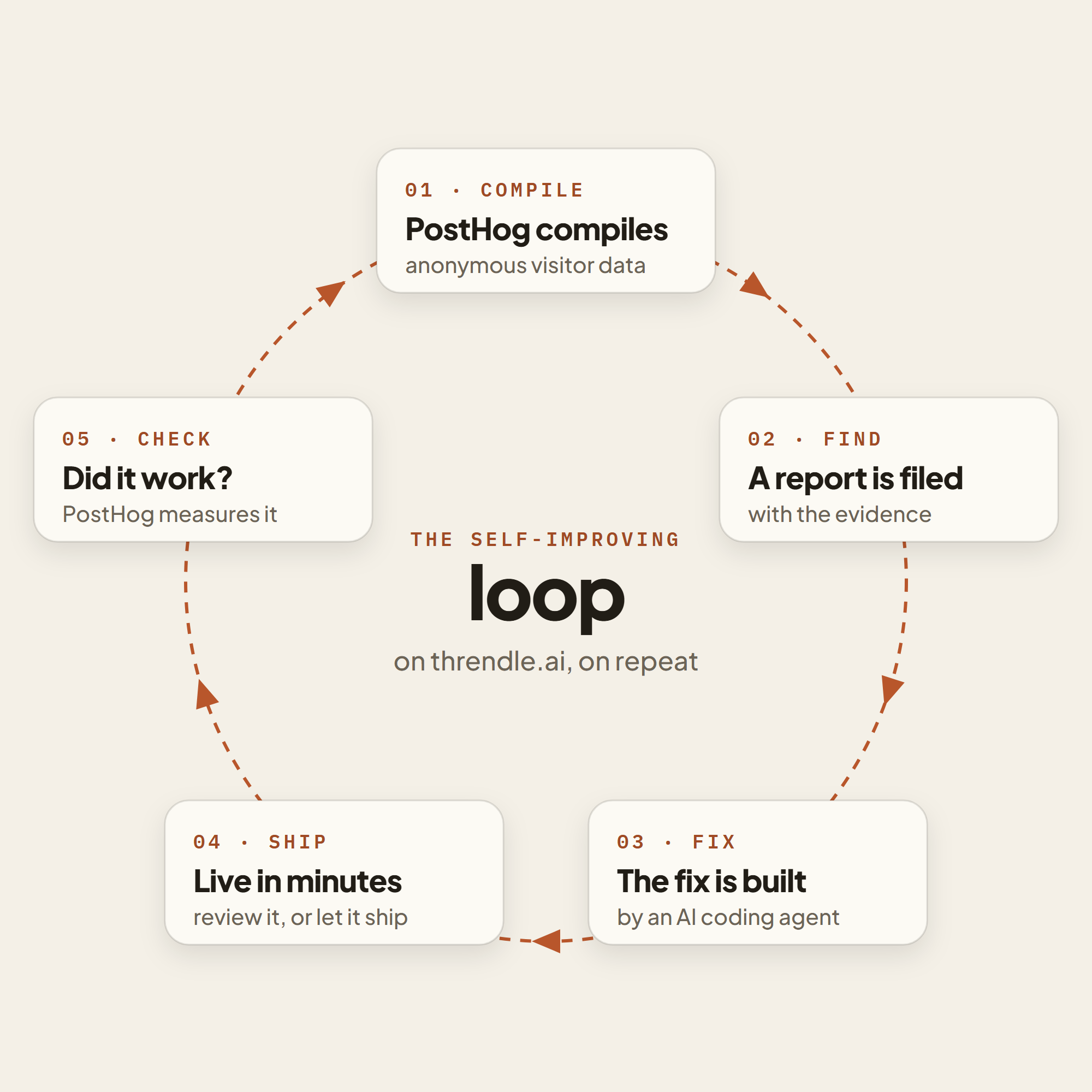
PostHog explains the feature this loop is built on in its self-driving guide.
What has it fixed so far?
As of September 13, 2026, the loop has filed 11 reports on threndle.ai: 10 were real problems and all 10 are fixed, and 1 turned out not to be a bug.
What hasn't it done yet?
It hasn't run an A/B test. That is where PostHog shows half the visitors one version of a page and half another, then keeps the better one. It needs more visitors than a new site like threndle.ai gets, so that test waits.
When can you get one?
Self-improving websites are coming soon as a threndle.ai service. They aren't open for booking yet. For now, threndle.ai is the test site, and this build log will show the results, including what breaks.