Blog · August 25, 2026 · James Forrester, with Claude
AI Isn't Taking Your Job. Not Learning to Run It Might.
The 2026 data on AI and work, and what it means for you.
I am not going to pretend this is abstract for me. I have watched it land on people close to me, who also felt it after an industry shift. So when someone tells me they are scared, I do not wave it off. The fear is real, and it is earned.
Here is the other thing I have seen, and it is why this is not a doom piece. The skills those two have, the taste, the eye, the judgment built over years, are exactly what it takes to point these tools in the right direction. That craft is not the thing AI replaces. It is the thing that decides whether the AI output is any good. Handled right, AI does not take that job. It augments it. The 2026 data mostly backs that up, including the parts that argue against me.
The Bottom Line
- No economy-wide job disruption from AI shows up in the data 33 months after ChatGPT launched (Yale Budget Lab, Oct 2025).
- Jobs that require AI skills paid a 56% wage premium in 2025, rising to about 62% in 2026 (PwC Global AI Jobs Barometer).
- Employment for workers aged 22 to 25 in the most AI-exposed jobs fell 13% since late 2022, while older workers in the same jobs held steady (Stanford, Brynjolfsson et al.).
- The dividing line is automate versus augment: AI bit hardest where it replaces a task, not where it assists one. Your applied skills are what turn it into assistance.
- The Industrial Revolution parallel holds, and its real lesson is that the transition took two generations. That is an argument to start now, not to wait.
The short answer
"AI is taking my job," said as a blanket claim about the whole economy, is not what the current numbers show, even though it is absolutely happening to specific people in specific fields. Both are true at once, and the honest version has to hold both. The version that says "it won't touch me" or "it will blow over" is the losing position, because every serious dataset shows AI spreading further, not pulling back.
The honest middle is this: the risk is not that a model replaces you. The risk is that you sit still while the people around you learn to direct these tools, and the gap between you and them turns into a hiring decision. And the skills you already have are the raw material for closing it. The eye, the craft, the judgment are what steer a model toward work worth shipping. That is not a job being replaced. It is a job being augmented, and it is how you join the new economy instead of watching it.
What the aggregate data actually shows
The most careful economy-wide study to date is from the Yale Budget Lab. Looking 33 months past the launch of ChatGPT, it found no clear link between a job's AI exposure and changes in employment or unemployment (Yale Budget Lab, October 2025). The mix of jobs in the economy is shifting slightly faster than it did during the personal computer or early internet years, but not dramatically so, and a lot of that shift started before ChatGPT existed.
That matches how every general-purpose technology has landed. Electricity, the PC, the internet: each took decades to reshape work, not months. Early alarm outrunning measurable impact is normal. It is not evidence that nothing is happening.
So if you are reading headlines that say the jobs apocalypse arrived, the wide-angle numbers do not back them up. Yet.
Where it is already biting
Here is the part that argues against comfort. The damage is real, and it is concentrated exactly where it does the most harm to a "just learn it" story.
A Stanford team led by Erik Brynjolfsson tracked payroll records from ADP and found a 13% relative drop in employment for workers aged 22 to 25 in the most AI-exposed occupations since late 2022, including software developers and customer-service reps. Employment for older, more experienced workers in the same jobs stayed flat or grew (Stanford / SIEPR, "Canaries in the Coal Mine?", updated August 2026). Firms are adjusting through headcount, not pay. They are hiring fewer juniors rather than cutting salaries. And the declines cluster where AI automates a task rather than assists with it.
Read that again, because it is the sharpest objection to my own argument. You learn to orchestrate AI by first doing entry-level work. That entry rung is the one being automated away. Telling a 23-year-old to "just skill up" is harder advice than it sounds when the on-ramp is the thing disappearing.
The one number that backs the whole case
Now the number that makes the argument for learning this. PwC analyzed close to a billion job ads across two dozen countries. In 2025, roles that required AI skills advertised a 56% wage premium over otherwise-comparable roles without them, up from 25% a year earlier. In the 2026 update, that premium rose to about 62% (PwC Global AI Jobs Barometer). Industries most exposed to AI saw labour productivity grow roughly three and a half times faster.

One caveat you should carry, because I do. That premium compares roles to each other, not the same worker before and after learning a skill. It does not control for seniority or employer. PwC says so itself. It is strong evidence that the market pays for AI-skilled work. It is not a promise that a weekend course earns you a 56% raise. The direction is not in doubt. The size, for any one person, is.
The Industrial Revolution parallel, and its real lesson
People reach for the Industrial Revolution comparison a lot, usually to say "we got through that, we'll get through this." That is true, and it is where the analogy gets dangerous, because it hides the timeline.
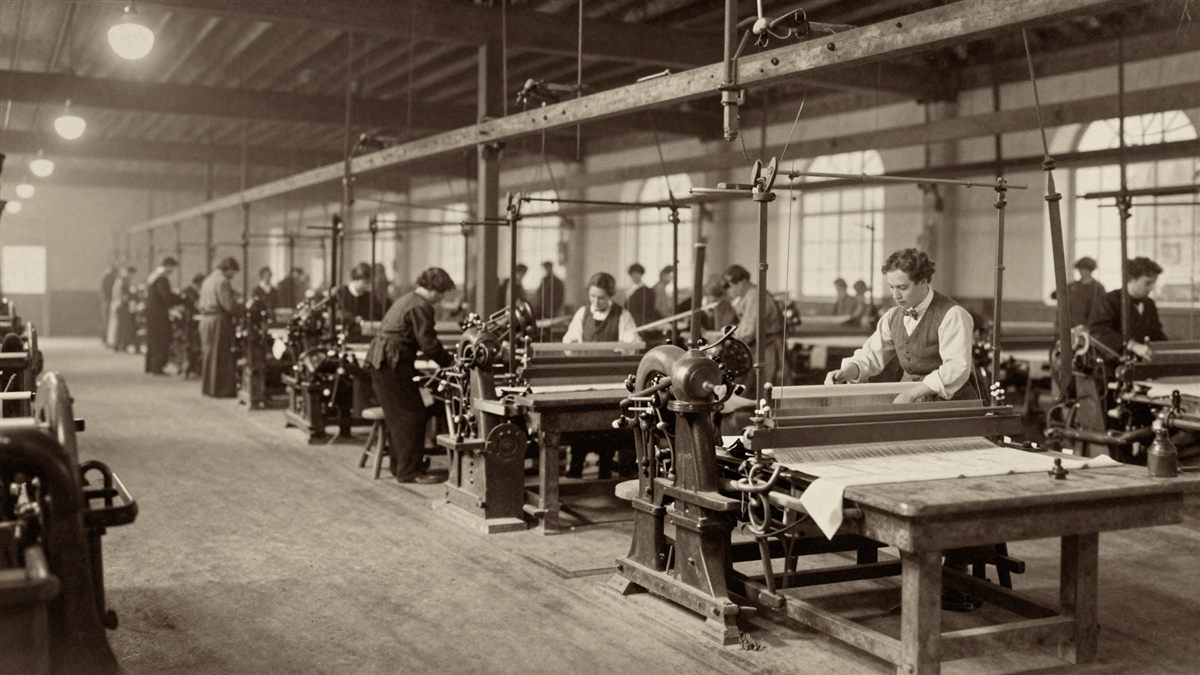
From roughly 1790 to 1840, British output per person grew about 46%, while working-class real wages rose only about 12%. Economic historian Robert Allen named this stretch Engels' pause. For about two generations, the machines paid off and the workers running them did not. The gains and the pain landed on different people.
It did work out. Real wages eventually caught up and living standards rose enormously. But "it worked out" over a span longer than a career is cold comfort if you are the handloom weaver living through the pause. The lesson is not "relax, it always balances." The lesson is that being on the right side of a long transition is not automatic, and the cost of waiting is measured in years you do not get back. That makes the case for learning now stronger, not weaker.
The strongest arguments against me
Here are the parts that cut against my view, straight.
The people who most need to reskill are the ones locked out
AI hits entry-level knowledge work hardest, and that is where you learn by doing (Stanford).
"Just retrain" has a weak track record
Studies of US retraining programs find they rarely move workers into less automatable work; gains come from wage recovery, not safer jobs (Brookings).
This time may be structurally different
Past automation created a rung one step up that absorbed displaced workers. Some economists argue AI targets the cognitive layer itself, and the next rung is less obvious.
The productivity payoff may be modest
Daron Acemoglu estimates AI raises total factor productivity by no more than about 0.66% over ten years (NBER 2024), well below more bullish forecasts.
None of these say "do nothing." They say the reassurance industry is lying to you when it promises reskilling is painless and universal. Learning to orchestrate AI is the right move for you as an individual. It is not a policy that makes displacement disappear for everyone. Hold both.
What "learn to orchestrate it" actually means
Orchestrating AI is not prompting a chatbot for a poem. It is wiring these tools into the boring, repeated work you already do and keeping your hand on the wheel. Reconcile yesterday's payments against the books. Chase invoices overdue past seven days. Draft the follow-up to a lead that went cold, then decide whether to send it.
The pattern that matters: the tool reads the data, does the draft, and asks you before anything goes out. You stop doing the repetitive part and start supervising work that runs itself. For most owners I work with, the time that frees up goes back into the two things software cannot do for them, talking to customers and finding the next one. That is the improvement. Not magic. Fewer hours lost to things that should have run on their own.
Being an autodidact is the whole skill here. Nobody is going to hand you a certificate that keeps up with this. The people who win the next few years are the ones who teach themselves in public, try the tool on a real task, watch it break, and fix it. That is uncomfortable and it is the job now.
So, am I right?
Mostly, and for a harder reason than I started with. "AI is taking my job" is not true at the level of the whole economy, and it may never be true in the crude way people fear. But sitting still is the actual risk, the premium for learning this is real and large, and the historical parallel everyone quotes for comfort is really a warning about how long and how unevenly these shifts play out.
Your skills are not the casualty here. Pointed at these tools, the taste and judgment you already have are the whole advantage, and using them that way is how you join the new economy instead of watching it from outside.
It is not stopping. Learning to run it is the move. And the best time to start was a year ago, which means the second best time is this week.
Sources
- Yale Budget Lab, "Evaluating the Impact of AI on the Labor Market: Current State of Affairs," October 1, 2025. budgetlab.yale.edu
- Brynjolfsson, Chandar, Chen et al., "Canaries in the Coal Mine? Six Facts about the Recent Employment Effects of AI," Stanford / SIEPR, updated August 2026. digitaleconomy.stanford.edu
- PwC, "2025 Global AI Jobs Barometer," June 2025. pwc.com
- World Economic Forum, "Future of Jobs Report 2025," January 2025. weforum.org
- Robert C. Allen, "Engels' Pause: Technical Change, Capital Accumulation, and Inequality in the British Industrial Revolution." en.wikipedia.org
- Brookings Institution, "AI labor displacement and the limits of worker retraining," 2025. brookings.edu
- Daron Acemoglu, "The Simple Macroeconomics of AI," NBER Working Paper 32487, 2024. nber.org